

























Clean copied text without merging paragraphs or losing list items
Compare soft line breaks, real paragraphs, duplicate lines and natural sorting on small samples.
Copied PDF text often contains line breaks inside sentences. A pasted list has a different problem: each line may be a separate record that must remain separate. Choose the transformation according to the structure you want to keep, and test a short representative extract before processing a longer document.
In this guide
Distinguish wrapped lines from paragraph boundaries
A useful sentence
continues here.

A new paragraph.

→
A useful sentence continues here.

A new paragraph.
In Remove Line Breaks, choose the option that preserves paragraph breaks when the source uses blank lines between paragraphs. Compare the result with the example above. The option that removes all breaks collapses whitespace into one continuous paragraph; it is useful for a single field, not for preserving an article’s structure.
Do not flatten a line-based list before sorting
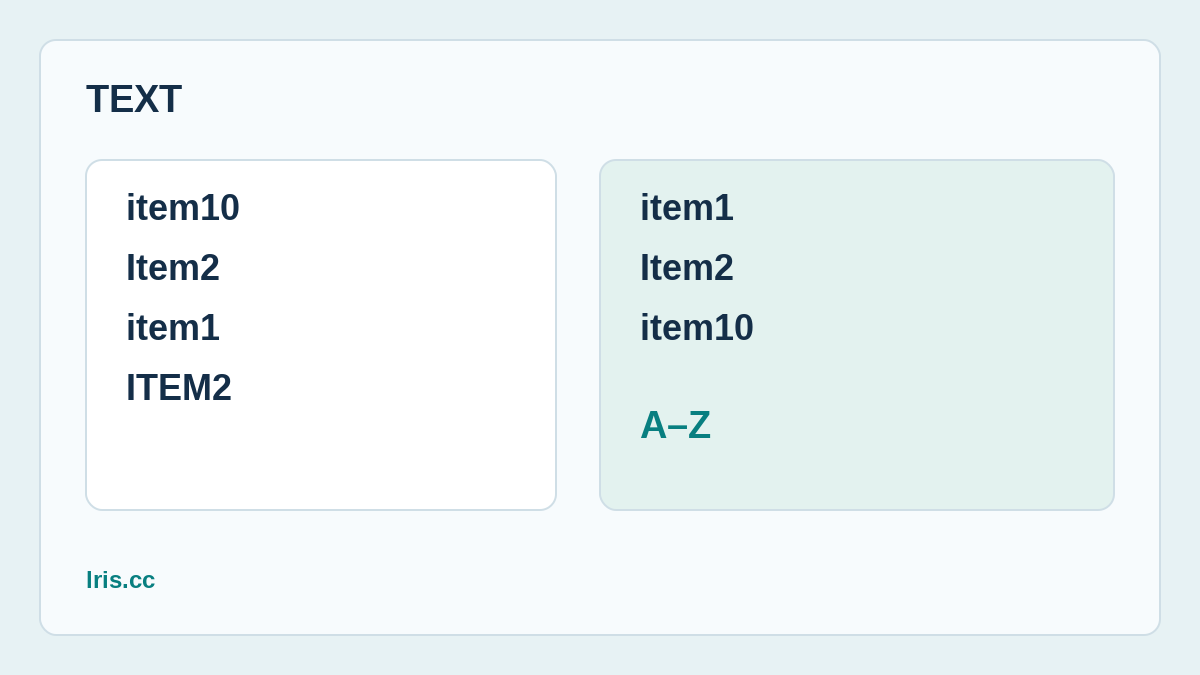
Text Sorter treats each input line as an item. If you remove all line breaks first, three items become one item and sorting can no longer rearrange them separately. Keep a copy of the list and perform sorting on that copy, independently of any paragraph-cleaning workflow.
item10
Item2
item1
ITEM2

→ A–Z
item1
Item2
item10- Use A–Z sorting on the sample. This sorter uses natural, case-insensitive ordering, so item2 comes before item10 rather than placing every item beginning with 1 first.
- Enable duplicate removal only if it matches your intent. In this tool Item2 and ITEM2 are duplicates and the first encountered spelling survives. Do not use this option when capitalisation distinguishes meaningful codes or labels.
Check counts with a known baseline
Alpha beta

Gamma

words: 3
paragraphs: 2
characters: 14
characters_with_spaces: 17
Run the baseline in Word Counter before interpreting a large document. Its word count groups letters and numbers using a pattern; it is not a linguistic segmenter for every writing system. A Chinese sentence without spaces may be treated as one run, so use the character count when that better matches your requirement.
Understand character-count differences
The whitespace-inclusive counter includes line-break characters, while the other counter removes whitespace. This baseline uses LF line endings; CRLF can change the inclusive count. Unicode code points also do not always equal visible symbols: combined accents and emoji can contain several code points. Agree on the counting rule before using a strict submission limit.
- After cleaning, inspect the beginning, a middle paragraph and the end. Confirm that blank-line paragraph boundaries, punctuation and item counts remain sensible. Never assume that a shorter result means it is more correct.
